
Russian President Vladimir Putin is set to visit China for talks with Chinese leader Xi Jinping, shortly after US President Donald Trump's visit to Beijing. The visit underscores the close strategic ties between China and Russia amid global tensions.

A Chinese official stated that India and China should view each other as cooperative partners and opportunities for development, not rivals or threats. This statement came in response to Russian President Vladimir Putin's comments on the independent and strong ties Russia maintains with both nations, emphasising non-interference in India-China relations.

A new report from the Stockholm International Peace Research Institute (SIPRI) indicates that India has expanded its nuclear arsenal and is developing long-range weapons capable of reaching targets across China, while also maintaining focus on its rivalry with Pakistan.

Russian President Vladimir Putin and Chinese President Xi Jinping have reaffirmed their commitment to dismantling global hegemonism and building a 'multipolar world' during high-level talks in Beijing.

Delhi must now purge the delusional hopes of being a 'counterweight' to China in the US calculus, argues Ambassador M K Bhadrakumar.

Russian Foreign Minister Sergei Lavrov will visit Beijing to discuss the West Asia conflict, the Strait of Hormuz blockade, and bilateral relations with Chinese leaders.

The US administration has ordered a probe into the deaths and disappearances of at least 10 top US scientists and researchers with access to information related to aerospace, defence and extra-terrestrial life.

Israel and the United States had a plan. Iran punched back. And now the Gulf is reeling, the world is beginning to feel the pain and, as on date, no one in Washington or Tel Aviv appears willing to admit that the punch has landed, notes Prem Panicker, continuing his must-read blog on the war in the Middle East.

China has reacted positively to Russian President Vladimir Putin's visit to India, emphasizing the importance of trilateral ties between China, Russia, and India for regional and global peace and stability.

In the Indo-Pacific's new era -- where perception shapes reality faster than treaties -- the real entrapment is not of China or the United States. It is the test Japan has set for itself -- and whether partners like India, acting as balancers rather than accelerants, can help ensure that the story ends in stability, points out Varun Arya.
Two days after Russian President Vladimir Putin concluded his visit to India, during which he assured that Moscow would remain a reliable energy supplier, the Kremlin on Monday said that India, as a sovereign nation, is free to buy oil from sources it deems beneficial. It expressed confidence that New Delhi will continue to prioritise its economic interests.
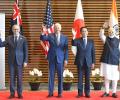
Chinese and Russian warplanes on Tuesday conducted joint air patrols over the Sea of Japan, the East China Sea and the West Pacific Ocean as the leaders of Quad held their in-person summit in Tokyo, in an apparent attempt to send a message of unity between Beijing and Moscow.
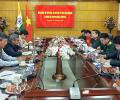
The 15th India-Vietnam Defence Dialogue signalled a move from routine talks to deeper cooperation, with new deals on submarine rescue and defence industry to support stability in the Indo-Pacific, notes Dr Rajaram Panda.
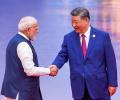
'When the Galwan incident took place, that was a big break in the trust factor between India and China.'
China has expressed its support for Russia's initiative to revive the Russia-India-China (RIC) troika, emphasizing its importance for regional and global security and stability.
'If they can be duplicitous, we can be equally duplicitous.' 'If they offer friendship, we reciprocate.' 'If they choose hostility, we respond with equal hostility.'

India briefed envoys of the US, UK, France, China, Russia, Germany and several other countries on the Pahalgam terror attack and its link to cross-border terrorism. Foreign Secretary Vikram Misri apprised the diplomats about various aspects of the dastardly terror attack on innocent civilians and India's firm policy of "zero tolerance" against terrorism. The briefing was held a day after India announced a raft of measures against Pakistan including expulsion of Pakistani military attaches, suspension of the Indus Water Treaty of 1960 and immediate shutting down of the Attari land-transit post. The Cabinet Committee on Security headed by Prime Minister Narendra Modi firmed up the punitive measures against Pakistan in view of the cross-border links to the Pahalgam attack that killed 26 people. Diplomats of Oman, the United Arab Emirates, Qatar, Norway, Italy, Indonesia and Malaysia were also part of the briefing. Prime Minister Narendra Modi vowed to punish terrorists behind the strike and said India's spirit will never be broken by terrorism.
'Within minutes, my mobile began ringing. It was National Security Adviser Brajesh Mishra, asking why the Iranians were complaining.' 'I explained that we had only restated our position in the light of the conclusion reached by the IAEA, but will remain helpful to Iran to reach a consensus.' 'Then came a call from Foreign Secretary Kamal Sibal, repeating what Mishra said about the Iranian complaint.' 'I was very impressed that Iran was able to reach two top officials in India to intervene at short notice,' recalls Ambassador T P Sreenivasan.
"The two sides note that the relationship between Russia and China has progressed to a more advanced interstate cooperation compared to the military-political unions of the Cold War era as it is not bloc or confrontational in nature, nor does it target any third countries," Russia's new agency Tass quoted the document as saying.

Special envoys of China, Russia and Pakistan have met the top officials of the Taliban's interim government as well as Afghan leaders Hamid Karzai and Abdullah Abdullah in Kabul and discussed the formation of an inclusive government, combating terrorism and humanitarian situation, a top Chinese official said on Wednesday.

During a weekly press briefing, the Foreign Office Spokesperson Mumtaz Zahra Baloch said that invitations have been sent to the heads of countries to participate in the meeting which will take place on October 15-16, the Dawn newspaper reported.
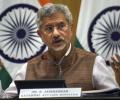
The last Indian external affairs minister to visit Pakistan was Sushma Swaraj. She had travelled to Islamabad in December 2015 to attend a conference on Afghanistan.
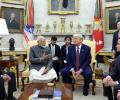
'By his words, actions, and body language during their joint press appearance wanted to convey his personal respect and, more broadly, his desire to work closely with India.'
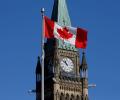
While there was no mention of India in the National Cyber Threat Assessment reports of 2018, 2020 and 2023-24, the 2025-26 assessment mentions India -- along with China, Russia, Iran and North Korea -- in the 'Cyber threat from state adversaries' section that introduces the state cyber threat ecosystem and discusses the cyber threats to Canada.

It is the first time in nearly nine years that India's foreign minister travelled to Pakistan even as the ties between the two neighbours remained tense over the Kashmir issue and cross-border terrorism emanating from Pakistan.
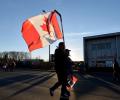
Canada's federal commission of inquiry into foreign interference is looking to examine alleged meddling by India in the country's last two general elections, Canada-based CTV News reported.
Donald Trump's exaggerated opinion of his dealmaking capacity can get him into trouble, observes R Sriram.

The leaders of the Quad comprising India, the United States, Australia and Japan are set to demonstrate that the grouping is a 'force for global good' and has a unifying commitment to a rules-based international order amid China's increasingly intimidatory behaviour.

New Delhi has reached out to Moscow while waiting for a new president in Washington. New Delhi knows well that in international relations, there are no permanent friends or foes, only permanent national interests, points out Dr Rup Narayan Das.

Ahead of his crucial talks with Russian President Vladimir Putin in Moscow, Chinese President Xi Jinping said on Monday that his peace plan to end the raging Ukraine war takes into account the 'legitimate' concerns of all parties and reflects the broadest common understanding of the international community.

India's defence sector presents an ordering opportunity worth $138 billion between fiscal years 2023-24 (FY24) and FY32, said a latest note by Nomura, which has initiated coverage on two defence-related players - Hindustan Aeronautics (HAL) and Bharat Electronics (BEL) - with a 'buy' rating. The research and broking house sees an upside potential of 28 per cent and 32 per cent, respectively in these two stocks from the current levels.

Shigeru Ishiba is expected to prioritise strengthening Japan's military capabilities and fostering deeper international partnerships, particularly with India, with whom Japan shares significant strategic interests, explains Dr Rajaram Panda.

Russia's unprecedented rapprochement with North Korea has raised concerns about the re-emergence of a Russia-China-North Korea alliance which could increase the probability of conflict on the Korean Peninsula, explains Dr Rajaram Panda.

Insider trading -- a punishable offence in the United States -- which increases stock market volatility, is relatively high in India, China, Russia, Venezuela and Mexico, according to a study done for the International Monetary Fund.
The Chinese side hopes that the next US administration will return to a sensible approach, resume dialogue with China, restore normalcy to the bilateral relations and restart cooperation, Wang, who is also a state councillor, told the state-run Xinhua news agency in an interview.

Pakistan Defence Minister Khawaja Asif will attend the SCO defence ministers' meeting in New Delhi on Friday through virtual mode, according to an official readout.


Defence Minister Rajnath Singh on Thursday held talks with his Chinese counterpart Li Shangfu and is learnt to have discussed the lingering border row in eastern Ladakh.
Addressing a symposium on the international situation and China's foreign relations in 2022, Wang said both countries have maintained communication through diplomatic and military-to-military channels.

India, China and Russia on Thursday held a trilateral meeting on Afghanistan's security situation against the backdrop of the US' plans to withdraw its troops from the war-ravaged country, raising fears of re-emergence of Taliban and al-Qaeda linked elements.
